- Free Consultation: (212) 991-8960 Tap Here to Call Us





New York’s Anti-Waiver of Employment Rights Act: What Workers Need to Know


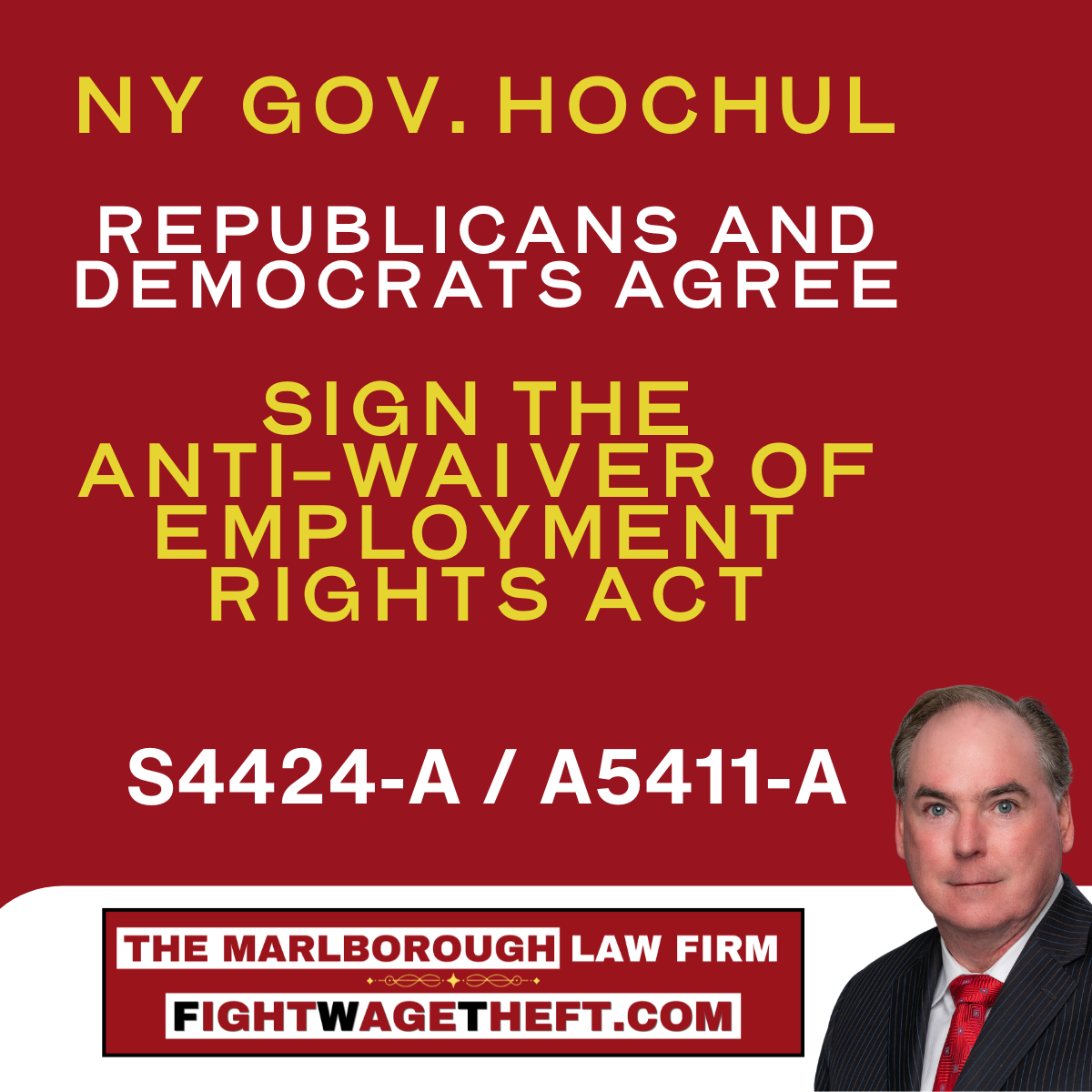
New York workers may soon get a powerful new legal tool. It would protect their rights under the state’s wage, hour, and anti-discrimination laws. The Anti-Waiver of Employment Rights Act passed both houses of the New York Legislature on May 13, 2026. The bill is Senate Bill S4424-A, sponsored by Senator Jessica Ramos, and Assembly Bill A5411-A, sponsored by Assemblymember Harry Bronson. The Assembly passed it with stunning bipartisan support, by a vote of 135-2. It now awaits action from Governor Kathy Hochul.
New York’s legislative custom often “calls up” passed bills for the Governor’s signature in batches. That typically happens near the end of the calendar year. There’s still time to make the case for why she should sign it.
“This bill passed with overwhelming, bipartisan support because the underlying facts are indefensible. Employers have been stacking the deck against their own employees, burying patently unfair contract provisions in paperwork that workers are required to accept just to get the job. This law puts a stop to it.”
Christopher Marlborough, Board Member and Legislative Advocacy Co-Chair, National Employment Lawyers Association – New York Affiliate (NELA/NY)
What the Anti-Waiver Act Does
The Problem It Targets
For years, some employers have buried provisions in employment applications and offer letters that strip away workers’ legal protections before a dispute ever arises. These provisions include arbitration agreements and class action waivers. One increasingly common tactic: employers require workers to agree to clauses that shorten how long they have to bring a claim. A worker might otherwise have six years to sue for unpaid wages or unpaid overtime. But onboarding paperwork can cut that window down to six months. The worker never got a chance to negotiate the term.
What the Bill Changes
The Anti-Waiver Act would add new provisions to the Labor Law (Section 219-e) and the Human Rights Law (Section 302). Together, they make clear that:
- Private agreements cannot waive or limit rights, remedies, or claims under the NYLL and NYSHRL. That’s true whether the waiver is written into the contract directly or only implied.
- Contractual provisions that shorten an employee’s statute of limitations for these claims are invalid.
- Contractual provisions requiring workers to waive their right to act collectively in a class or collective action are invalid. The exception: cases where federal law preempts them.
- Contractual provisions requiring workers to waive their right to sue in court are invalid, unless federal law preempts them.
- Collective bargaining agreements remain unaffected. Workers can still voluntarily settle claims or sign severance agreements after a dispute arises.
- The law doesn’t apply where federal law preempts it. That covers most arbitration agreements, along with the class action waivers packaged inside them.
- The law includes a severability provision. If a court strikes down one part, the rest of the law stays in force.
The Class Action Waiver Mechanics
One provision deserves its own explanation: the bill would ban standalone, pre-dispute class action waivers. These are class action waivers that exist outside of an arbitration agreement. Right now, some employers require workers to give up their right to bring or join a class action. They do this as a plain contract term, with no arbitration requirement attached. The Anti-Waiver Act would void that practice.
Federal law supersedes state law on the enforceability of arbitration agreements. So the bill excludes any provision inconsistent with the Federal Arbitration Act. That federal law generally shields arbitration agreements, including the class action waivers built into them, from state interference.
Why the Anti-Waiver Act Is Needed Now
New York Courts Have Split on the Issue
Some New York courts have upheld severely shortened limitations periods. In one case, an appeals court called it “inherently reasonable” for an employer to cut a discrimination claim’s filing window. The window went from three years down to six months. Another case enforced a provision limiting the time to bring any employment claim to just six months. As a result, the court dismissed the worker’s Human Rights Law claims.
Federal courts sitting in New York have gone the other way. They’ve consistently held that similar shortening provisions are void as against public policy under the federal Fair Labor Standards Act. That creates an uneven playing field: the same conduct gets treated differently depending on which statute a worker sues under. The Anti-Waiver Act closes that gap and puts NYLL and NYSHRL claims on the same footing as their federal counterparts.
Other States Are Confronting the Same Problem
New York isn’t alone here. New Jersey went further than court rulings alone. Under N.J.S.A. 10:5-12(r), requiring a worker to consent to a shortened statute of limitations is an unlawful employment practice. The New Jersey Supreme Court separately struck down such a clause in Rodriguez v. Raymours Furniture Co. (2016).
The Michigan Supreme Court recently overturned decades of precedent that had made shortened filing deadlines in employment paperwork automatically enforceable. In Rayford v. American House Roseville I, LLC (2025), the court changed that rule. Judges must now scrutinize boilerplate acknowledgment forms and applications for basic fairness before enforcing them.
At the federal level, the Sixth Circuit reached a similar conclusion in Boaz v. FedEx Customer Information Services, Inc. (2013). The court held that employees cannot waive their FLSA rights by contract, including through a shortened filing deadline. Federal district courts within the Second Circuit, which covers New York, reached the same conclusion on FLSA claims specifically. That includes Castellanos v. Raymours Furniture Co., 291 F. Supp. 3d 294 (E.D.N.Y. 2018). There, the court severed the shortened limitations period from the parties’ arbitration agreement.
Legal scholars have raised similar concerns. A 2024 law review article on Title VII discrimination claims argues that shortened-limitations clauses are fundamentally unfair. The reasoning: there’s a real power imbalance between an applicant and an employer at the moment of hiring. A worker rarely has any realistic chance to negotiate boilerplate paperwork stapled to a job offer.
A Timely Boost for the Anti-Waiver Act From the Court of Appeals
Just one day before the Legislature sent the bill forward, the New York Court of Appeals issued a relevant decision. That ruling reinforces exactly what the Anti-Waiver Act is meant to codify. In Walton v. Comfort Systems USA (Syracuse), Inc., decided June 23, 2026, New York’s highest court addressed the issue directly. It unanimously held that a contract clause was unenforceable. The clause had shortened the time limit for prevailing-wage claims under Labor Law § 220. The underlying right came from the statute itself, not from anything the parties negotiated. So a private contract couldn’t cut it short.
The reasoning in Walton lines up closely with the goal of the Anti-Waiver Act. When the Legislature creates a right for workers’ protection, employers shouldn’t get to quietly take it away through contract terms. That’s especially true for terms workers had no real chance to negotiate. But Walton only addressed prevailing-wage claims narrowly. It doesn’t reach every type of waiver. And it doesn’t override the older appellate decisions that went the other way on NYLL and NYSHRL claims generally. That’s exactly the gap the Anti-Waiver Act is designed to close.
A Get-Out-of-Jail-Free Card for Wage Thieves
Testimony From the Front Lines
I testified on this issue on March 4, 2026, before the Senate Standing Committees on Codes and Consumer Protection. The joint hearing was titled Current Patterns in White-Collar Crime and Fraud, and Possible Updates to Laws Protecting New Yorkers and Markets. I spoke about how these waivers function in practice. It’s rarely as simple as a legitimate employer protecting itself from stale claims. In my experience representing workers, aggressive stacking of these provisions is a red flag. Those employers tend to be the ones with the most to hide.
How the Scheme Works
Here is an example of how the scheme works. An employer sets up a fraudulent independent contractor scheme, classifying workers who are, in every functional sense, employees. That lets the employer avoid paying minimum wage, overtime, and payroll taxes. It also lets them sidestep basic protections like workers’ compensation and unemployment insurance. Then the employer adds a class action waiver, a shortened statute of limitations, and a forced arbitration clause. All three are buried in the same “independent contractor agreement” the worker has to sign just to start the job. They go in before any dispute has even happened, offered on a take-it-or-leave-it basis.
Why That’s So Dangerous
The more illegal the underlying scheme, the more valuable these waivers become to the employer running it. A misclassified worker typically doesn’t find out until much later. Sometimes it’s not until tax season. Other times, it’s not until they get hurt on the job and discover they have no workers’ compensation coverage. By the time they realize what happened, a shortened limitations period may have already run out.
The class action waiver compounds the problem. It bars workers from banding together. An employer stealing from a hundred workers only has to worry about the rare worker who discovers the scheme. That worker must hire a lawyer and force arbitration alone, win or lose, in private, off the public record. For a dishonest employer, that’s a trade worth making.
That’s why the Anti-Waiver Act matters beyond any single clause it invalidates. It closes off a strategy that lets the worst-behaving employers use their own contract paperwork as a shield. That shield insulates illegal conduct from the very legal processes meant to catch it.
Watching the Anti-Waiver Act Assembly Floor Debate:
Bill sponsor Assemblymember Harry Bronson wasn’t the only one who made the case for this legislation on the Assembly floor. Assemblymember Mary Beth Walsh is the Assembly Minority Leader Pro Tempore and a practicing attorney of over 30 years. She questioned Bronson closely during the May 13 floor debate. The exchange is worth watching in full.
Walsh opened skeptically. She pointed out how much New York has already done to protect workers from one-sided contract terms. Then she pressed Bronson on why this bill was needed on top of existing law. She initially framed her concern around freedom of contract. Sophisticated, represented employees negotiating written agreements should be able to bargain for themselves, she argued, without the state stepping in.
How Skepticism Turned Into Support
Bronson’s answer shifted the terms of the debate. He explained that courts have found an ordinary job application itself can count as an employment agreement. Under that theory, courts have upheld provisions cutting a six-year statute of limitations down to as little as six months. Bronson described those changes as reductions of 87 to 95 percent.
That answer visibly changed Walsh’s thinking in real time. She noted the practice “seems egregious.” By the end of the exchange, she told Bronson she planned to support the bill. She drew a distinction between two very different situations. One is an executive negotiating a contract with counsel present. The other is a worker who unknowingly signs away rights just by filling out a job application. The bill passed the Assembly by an overwhelming bipartisan vote of 135-2.
It’s a rare thing to watch a legislator’s position change live on the floor. It’s also a strong signal for Governor Hochul to bear in mind as she considers whether to sign the bill. That is, even members who instinctively favor keeping government out of private contracts found this status quo indefensible. They didn’t want to keep letting employers enforce these provisions against workers so easily.
What the Anti-Waiver Act Means for New York Workers
Did you sign an employment application, offer letter, or agreement? Did it include a clause shortening your time to bring a wage or discrimination claim? That provision may not hold up, regardless of whether the Anti-Waiver Act becomes law. Courts increasingly recognize that these statutory protections belong to workers, not to fine print an employer inserted into hiring paperwork.
Christopher Marlborough is Board Member and Legislative Advocacy Co-Chair of the National Employment Lawyers Association – New York Affiliate (NELA/NY). He has testified before the Legislature in support of the Anti-Waiver of Employment Rights Act and related worker-protection legislation.
Support the Anti-Waiver Act
The Anti-Waiver of Employment Rights Act passed the Legislature by a wide margin and now sits waiting for Governor Hochul’s signature. If you believe New York workers deserve these protections, contact Governor Hochul’s office. Urge her to sign the Anti-Waiver of Employment Rights Act into law.
Get in Touch
Fill out the contact form or call us at (212) 991-8960 to schedule your free consultation.


