- Free Consultation: (212) 991-8960 Tap Here to Call Us





Gov. Hochul Sign the Personnel Records Bill: New York Workers Deserve to See Their Employment Records


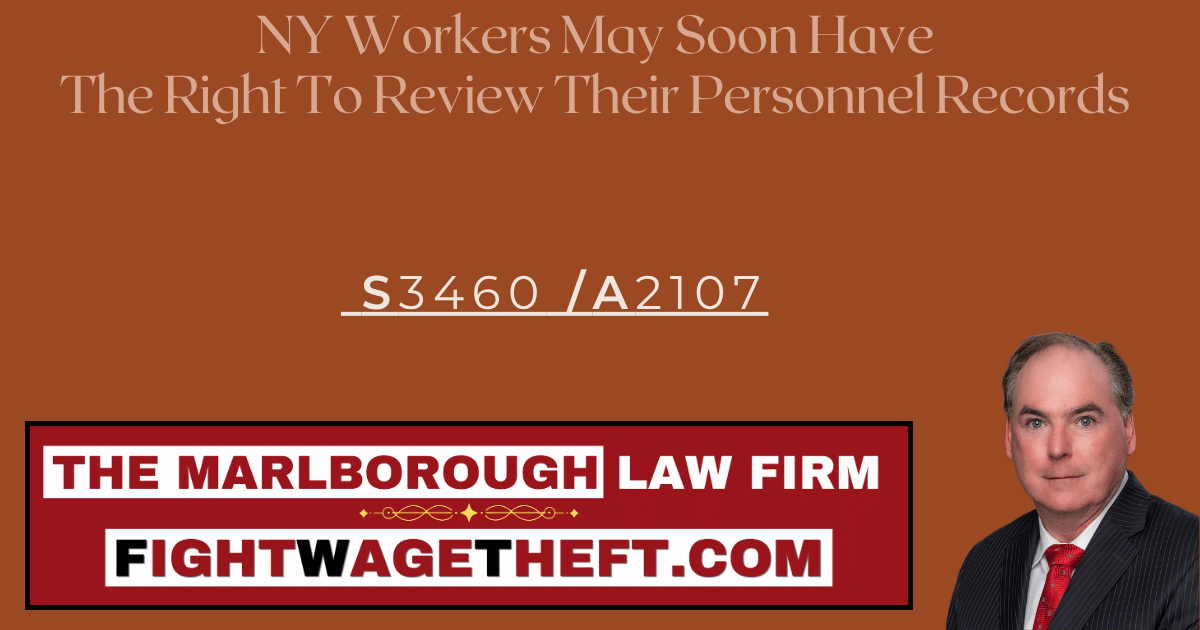
For decades, your personnel file has belonged to your employer, not to you. If a supervisor wrote something false or unfair into your record, you had no legal right to see it. You could not correct it, or even know it existed, unless you were already in a lawsuit and got it through discovery. The Personnel Records Bill (S3460/A2107) ends that. It passed both houses of the New York Legislature and is now headed to Governor Hochul’s desk. It is one of several worker-protection bills the Governor could and should sign before Labor Day, including the Remedial Construction of NY Labor Law Act, the Anti-Waiver of Employment Rights Act, and the Wage Payment Integrity Act.
What the Personnel File Records Bill does
S3460, sponsored by Senator Andrew Gounardes (D-26, Brooklyn), and its Assembly companion A2107, sponsored by Assemblymember Jessica González-Rojas (D-34, Queens), add a new Section 210-b to the New York Labor Law. The new section is modeled on Massachusetts’ longstanding Personnel Record Law. It gives every employee in New York, public and private sector alike, the right to:
- See your own file. Employers must hand over a complete copy of your personnel record, at no cost, within five business days of a written request. You get two of these requests per calendar year.
- Know when something negative is added. If your employer places negative information in your file, they must notify you within 10 days.
- Respond to what’s in there. Once notified, you can request the negative record and submit a written statement responding to it. That statement becomes a permanent part of the file. It travels with the record whenever the employer shares it with anyone else. This request doesn’t count against your two-per-year limit.
- Seek expungement of false information. If your employer knew, or should have known, that something in your file is false, you can pursue removal of it through the courts, a collective bargaining agreement, or other personnel procedures.
What qualifies as a personnel record?
The Personnel Records Bill defines a “personnel record” broadly as any record your employer keeps that identifies you and is used, or could be used, in decisions about your employment, promotion, transfer, pay, or discipline. That covers your name, address, and date of birth, your job application and resume, your pay rate and compensation history, your start date, and the disciplinary and evaluative records that so often determine whether you get promoted or get fired.
The Bill excludes information about other people where disclosure would be an unwarranted invasion of their privacy.
Employers also can’t simply purge your file the moment you’re gone. The employer must retain a complete personnel record from your hire date until three years after your separation. There’s no deadline for former employees to request access.
New York isn’t breaking new ground here. It’s catching up. Roughly two dozen other states already give employees some form of access to their own personnel files. New York has had no such law at all, for either the public or private sector.
How the Personnel Records Bill passed
The Senate passed S3460 on April 22, 2026, by a vote of 38-21. It was a straight party-line tally, with every Democrat in favor and every Republican opposed. The Assembly followed on May 19, 2026, passing A2107 by a closer margin of 92-49. This bill moved on Democratic votes alone. That fact tells you something about how hard the business lobby fought it, and how important it is to get it over the finish line now that both chambers have passed it.
States That Already Give Workers Access to Their Personnel Records
At least 22 other states already provide some form of employee right to inspect or copy personnel records, though the scope and strength of these laws vary widely:
State State State Alaska Maine Ohio California Massachusetts Oregon Connecticut Michigan Pennsylvania Delaware Minnesota Rhode Island Florida Nevada South Carolina Illinois New Hampshire Washington Iowa North Carolina Wisconsin Louisiana Coverage differs from state to state. Some cover only current employees, some allow inspection only rather than copies, and some apply only to public-sector workers. Currently, New York has no personnel file access law at all.
Why it matters
Right now, if your employer writes something untrue into your file, you may never know. You could be passed over for a promotion, denied a raise, or fired. The paper trail justifying it could sit in a filing cabinet you can never open. We see the consequences of that opacity constantly in wage and hour and retaliation cases. Workers can’t explain a sudden negative review that appeared right after they complained about unpaid overtime. They never had a chance to see it, question it, or respond to it before it became the official record used against them.
Massachusetts has required this kind of access for years without the workplace chaos employer groups warn about. What it has done is give employees a fair shot to correct the record while it still matters, instead of finding out for the first time in a courtroom.
This bill can also cut down on litigation itself, not just the harm that leads to it. Right now, a worker who suspects retaliation or discrimination often has no way to confirm what’s actually in their file without filing suit and forcing the issue through discovery, sometimes months or years after the fact. Give employees the right to request that information directly, and many disputes can resolve, or avoid altogether, before a lawsuit ever becomes necessary. Workers get answers faster. Employers face fewer claims built around records nobody could see until litigation forced the issue.
“In employment law cases, I constantly see workers who have no idea what is written about them in their own file until it is revealed in litigation discovery, sometimes years after a negative review or write-up was used to justify cutting their hours or firing them outright. This bill lets a worker find out what’s being said about them while there’s still time to correct it, not after they’ve already lost their job and have to sue to find out why.”
— Christopher Marlborough, The Marlborough Law Firm
Once Governor Hochul signs it, employers will have 60 days to put compliant policies in place.
Take action
This bill will only become law if Governor Hochul signs it by the end of the year. If you believe New York workers deserve to know what is in their own personnel files, contact Governor Hochul’s office and urge her to sign S3460/A2107.
Get in Touch
Fill out the contact form or call us at (212) 991-8960 to schedule your free consultation.


